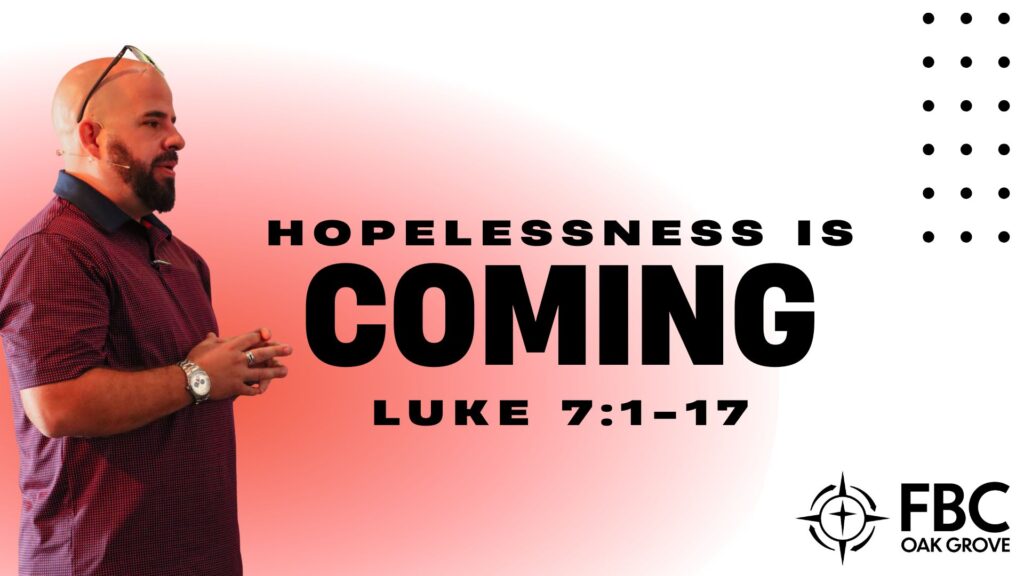
When Life Feels Hopeless (But You’re Not)
Luke 7:1–17
At some point, every one of us will hit a moment that feels utterly hopeless.
A doctor walks in with results you didn’t want.
A relationship you banked on falls apart.
A job ends without warning.
A future you thought was secure suddenly isn’t.
Hopelessness is that sinking sense that nothing good can come from this — no expectation of success, just despair.
In Luke 7, we meet two people who are living that reality in real time:
- A Roman centurion whose beloved servant is “sick and about to die”
- A widow whose only son has just died and is on his way to the grave
Two different stories.
One common thread: humanly speaking, it’s over.
But in both scenes, Jesus steps into hopelessness and shows us something crucial:
For the child of God, there is no such thing as a truly hopeless situation.
Let’s walk through what this passage teaches us—and how we can live it out this week.
1. You Will Face Hopeless Moments
“A centurion’s servant, who was highly valued by him, was sick and about to die.” (Luke 7:2)
“A dead man was being carried out. He was his mother’s only son, and she was a widow.” (Luke 7:12)
These aren’t minor inconveniences. These are life-shattering moments.
And whether you feel it now or not, you and I are on a collision course with something that will feel like this. You may not be in a storm today, but:
- You’re either in a storm,
- Just coming out of one, or
- Heading toward one.
That’s not meant to scare you. It’s meant to prepare you.
Because when that moment comes, the question will not be, “Is this hard?” (It will be.)
The question will be, “Where is my hope anchored?”
2. Jesus Has Authority Over Hopelessness
The centurion sends people to Jesus with a simple request: come heal my servant. But as Jesus gets close, the centurion sends another message:
“Lord, don’t trouble yourself, since I am not worthy to have you come under my roof… But say the word, and my servant will be healed.” (Luke 7:6–7)
This man understands authority. As a Roman officer, he says, “I tell soldiers to go and they go. Come and they come. Do this and they do it.”
He’s saying to Jesus:
“I recognize that sickness is under Your authority the way soldiers are under mine. You don’t have to be physically here. Just speak, and reality will obey.”
And Luke tells us: they return home to find the servant healed.
Here’s the takeaway:
There is nothing you’re facing that is outside the command of Christ.
- Diagnosis? Under His authority.
- Finances? Under His authority.
- Future? Under His authority.
- Even death? Under His authority.
That doesn’t mean Jesus always answers how we want or when we want. Sometimes He gives earthly deliverance. Sometimes He gives heavenly deliverance and brings us Home.
But it does mean this:
You will never face a situation where Jesus shrugs and says, “There’s nothing I can do about that.”
This Week: Submit Your Hopelessness to His Authority
If you’re walking through something heavy:
- Name it specifically before God. “Lord, this feels hopeless: _______.”
- Then confess what’s also true: “But it is not outside Your control. You have authority over this.”
- Keep coming back to that, even when your feelings scream the opposite.
Faith isn’t pretending the problem is small.
Faith is remembering that Jesus is bigger.
3. Faith in the Middle of Hopelessness
Faith can sound abstract until you define it simply:
Faith is taking God at His word.
The centurion models this beautifully:
“But say the word, and my servant will be healed.” (v. 7)
He’s basically saying, “Jesus, I don’t need a sign, a show, or a visit. I just need Your word. That’s enough for me.”
But notice something else: this man didn’t suddenly get “super faith” in a crisis out of nowhere.
- He already cared deeply for his servant (rare in that culture).
- He already loved the Jewish nation.
- He had already helped build a synagogue.
In other words, he was living a steady, faith-shaped life before the crisis hit.
If you want to have a resilient faith in hopeless moments, you need to be walking by faith in the normal moments.
We often want faith that can move mountains, but we ignore faith that:
- Obeys God in small decisions
- Honors Him with money, time, and priorities
- Says “yes” when He nudges us out of our comfort zone
This Week: Practice Faith Before the Storm Gets Bigger
Ask yourself:
- Where is God asking me to obey Him right now—not someday?
- Is there a clear next step I’ve been putting off?
Then do something small but concrete:
- Start the hard conversation He’s put on your heart.
- Give or serve where He’s telling you to, even if it stretches you.
- Share your faith with the person He keeps bringing to mind.
Every simple step of obedience is like laying another brick on a foundation that will hold when the flood comes.
4. Jesus Has Compassion for Your Hopelessness
The second story in Luke 7 is gut-wrenching:
A widow has already buried her husband. Now her only son has died. She’s walking in the funeral procession toward the grave.
If anyone feels hopeless, it’s her.
And what happens?
“When the Lord saw her, he had compassion on her and said, ‘Don’t weep.’ Then he came up and touched the open coffin… ‘Young man, I tell you, get up!’” (Luke 7:13–14)
Before she prays.
Before she asks.
Before she says anything.
Jesus sees her.
Jesus feels for her.
Jesus moves toward her.
That’s His heart.
- He doesn’t roll His eyes at your tears.
- He doesn’t get tired of your weakness.
- He doesn’t shame you for feeling overwhelmed.
He has compassion on you—even when you don’t know what to say.
And that compassion goes deeper than just fixing earthly pain. Our biggest hopeless problem isn’t sickness or finances—it’s sin and separation from God.
We could never fix that. But Jesus stepped into our hopelessness, went to the cross, and paid the price we couldn’t pay so we could be forgiven and made new.
If He went that far to deal with your ultimate hopelessness, you can trust that He cares about what you’re facing today.
This Week: Cast Your Cares, Don’t Carry Them Alone
- Take 5–10 quiet minutes this week and be brutally honest with God.
- Tell Him where you feel scared, angry, numb, confused, or exhausted.
- Don’t pretty it up. Just bring it to Him.
- Then ask: “Lord, help me believe You really care about this—and about me.”
5. There Is Real Hope in Hopelessness
After Jesus raises the widow’s son, Luke says:
“Fear came over everyone, and they glorified God, saying, ‘A great prophet has risen among us,’ and ‘God has visited his people.’ And this report about him went throughout all Judea and all the vicinity.” (Luke 7:16–17)
When God steps into a hopeless situation, it doesn’t just comfort the person involved—it testifies to everyone watching.
People stuck in a world where only the possible seems real become curious when they see the impossible break in.
That’s true physically, and it’s most true spiritually.
The greatest miracle any of us can experience is going from:
- Spiritual death → spiritual life
- Guilty → forgiven
- Enemy of God → child of God
That’s what Jesus offers.
“For all have sinned and fall short of the glory of God…
For the wages of sin is death, but the gift of God is eternal life in Christ Jesus our Lord.”
“For God so loved the world that he gave his one and only Son, that whoever believes in him shall not perish but have eternal life.”
You cannot rescue yourself.
But Jesus can. And He delights to.
If You’re Not Yet a Follower of Jesus
Your deepest hopelessness isn’t your circumstances—it’s being separated from God. The good news is:
- Jesus died for your sin.
- Jesus rose again.
- Jesus offers forgiveness, new life, and real hope.
You can respond in simple faith:
“Jesus, I know I’m a sinner and I can’t fix myself.
I believe You died and rose again for me.
Today I turn from my sin and trust You as my Lord and Savior.
Take my life. Make me Yours. Amen.”
If you do that, your external circumstances may not change overnight—but your eternal situation just did.
Living This Out This Week
Whether you feel hopeless right now or you’re in a calm season, here are a few ways to walk this out:
- Anchor your mind in His authority.
Pick one promise from Scripture (like Matthew 19:26 or Romans 8:28) and meditate on it every day this week. - Take one step of obedience.
Don’t wait for the “big” moment. Obey God in one clear, specific area you already know He’s speaking about. - Share a story of God’s faithfulness.
Tell someone (a friend, small group, or family member) about a time God met you in a hard place. Let your story point them to hope. - Refuse to walk alone.
Reach out to a trusted believer and say, “Here’s where I feel hopeless. Will you pray with me and walk with me?”
You may not be able to control when hopeless moments show up at your door.
But in Christ, you are never stuck there alone.
Hopelessness may be coming.
But so is Jesus.
And where He is, there is always hope.